


88 Key Portable Digital Piano For Kids-factory
Description
Technical Parameters
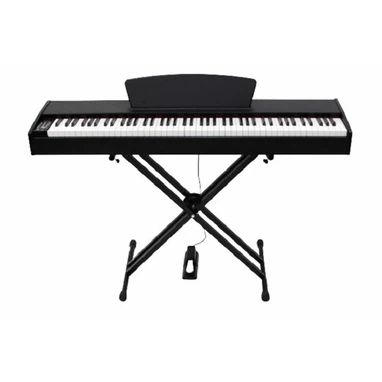
What Is 88 Key Portable Digital Piano?
An 88-key portable digital piano is a musical instrument that replicates the sound and feel of a traditional acoustic piano but in a more compact and portable form.
An 88 key portable digital piano has the same number of keys as a standard acoustic piano, which allows for a full range of musical expression. However, it is also designed to be lightweight and easy to transport, making it ideal for musicians who need to perform or practice in different locations.
BEISITE: Wholesale 88 Key Portable Digital Piano for Kids Manufacturer
Experienced Company
Jinjiang Beisite Electronic Technology Co., Ltd was established in 2012 and is an experienced company. Our annual production capacity is 80000 cartons. With an export license, we export products to Europe, America, Southeast Asia, and the Middle East. Our products gain wide praise at home and abroad.
Superior Quality
Quality is a priority at Beisite. All digital piano developed and manufactured by Beisite leaves the factory fully calibrated according to the most stringent industrial standards in force today. Our Certificates include FCC, EMC, Rosh, LVD, CE, PSE, etc.
Advanced Equipment
We not only have professional workers but also have the continuous updating of hardware equipment. Such as advanced facilities of an automatic Plug-in Machine, Automatic Welding Machine, High-Pressure Tester, High-Temperature Tester, and Vibration Tester.
After-Sale Service
We promise to provide customers with one year of after-sales support. Our sales team will try our best to give good after-sale service, handle customer complaints, and solve problems for customers.






Features of 88 Key Portable Digital Piano for Kids
Instead of using strings and hammers like acoustic pianos, digital pianos use electronic sensors and sound samples to produce piano sounds. They often come with various built-in features such as different instrument sounds, metronomes, and connectivity options.
expansion
How Many Keys of Keyboards Do You Need?
Keyboards come in numerous sizes, with the standard being 88 keys. Smaller keyboards are available with 76, 61, 49 and even 25 key options out there. When starting out, it's best to go for something that can accommodate two-handed playing straight away, or you'll be wanting to upgrade sooner than you think. For this, you'll need at least 49 keys or four octaves.
As a general rule - bigger is always better. Go for as many keys as you have room for, or your budget will allow. Buying a full-sized keyboard piano at the beginning means your new instrument has room to grow with you as you progress on your keyboard-playing adventure.
Benefits of Using Portable Digital Piano for Kids
Most digital pianos let you plug in headphones, which can benefit the learner (and the people they live with). As well as avoiding distractions, headphones can block outside noise leaving you free to concentrate on private practice. Twin headphone jacks also allow students and teachers to listen closely, spotting mistakes more accurately.
Timing is essential to playing the piano well, but it's often an issue for beginners who are developing muscle and mental memory. Metronomes (clicks) help develop your rhythmic and timekeeping skills and give you a solid tempo to rely on. With digital pianos, you can change tempo easily, meaning you can slow down when you're practicing something, or speed up when you want to challenge yourself.
Recording your performance helps analyze exactly what's going on in your playing so you can recognize your strengths and weaknesses. The record features on digital pianos allow you to play back, perfect, and pick out any problems, nipping bad habits in the bud before they become ingrained. Listening back to a recording can resolve issues with timing and melody, and if you have a good musical memory but are still learning to read music, you can learn a piece by ear and study the music while listening back to your recording.
A digital piano allows you to transfer your performance to a computer, edit it, and print out a score (the written piece of music also known as sheet music) so others can read and play it too. This is also useful if you're interested in composition as you can quickly record ideas as they come to you.
Digital pianos are often equipped with a huge variety of sounds – five to 10 types of piano, electric pianos from the 70s and 80s, strings, harpsichord, church, and electronic organs – some even have synth sounds for greater versatility. It's great to be able to learn Bach pieces using a convincing harpsichord sound; a change in tone can inspire you and help recapture the passion if those fingering drills are becoming tiresome. Younger children also love experimenting and mixing sounds to make learning more exciting.
Most Common Types of Stands for Keyboards or Digital Pianos
X-Stand
X-stands are the best choice for portability and cost-effectiveness. They are lightweight, portable, and collapsible, making them easy to set up and transport for gigs or rehearsals. They also store easily. Their adjustable X-shaped arms can be extended or retracted to accommodate different keyboard sizes. However, X-stands may not be as stable as some other types of stands.
Double-X Stand
Double X-style stands are an improvement on the X-stand design. They feature two crisscrossed legs on each side, providing a more robust and stable foundation, while still being portable. This makes them ideal for supporting heavier or larger equipment, such as digital pianos or heavy synthesizers.
Z-Stand
These stands feature a sturdy Z-shaped design that provides enhanced stability and weight capacity compared to an X-stand. They offer a secure platform for heavier keyboards or professional setups. Z-stands often come with adjustable height and width settings, allowing you to customize the stand to your preferred playing position. However, they may be less portable and bulkier than X-stands.
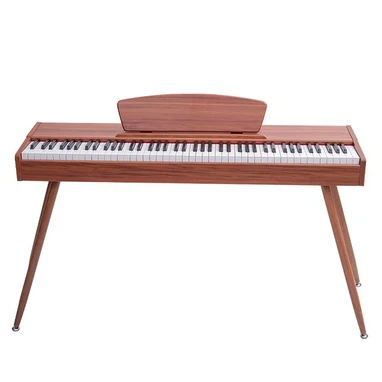
Furniture or Console-Style Stand
These stands are keyboard-specific and offered by manufacturers for their portable digital-piano models. Better suited for home use, they come in a variety of classic and elegant designs that complement the aesthetics of your keyboard, while adding a nice touch to the décor of your family room. Console-style stands also provide the necessary stability and playing height for a realistic piano-playing experience. They can also be equipped with a three-pedal system that replicates the functionality of a grand piano.

Dimensions of a Typical 88 Keys Digital Piano
The size and weight of digital piano vary depending on a lot of factors including but not limited to its model, brand, and the number of keys it has. Here are the typical dimensions of a digital piano that has 88 keys:
Length
The length ranges from 48 inches to 60 inches. The average length is around 53 inches.
Width
The width ranges from 10 inches to 16 inches. The average width is around 14 inches.
Height
The height ranges from 28 inches to 50 inches. The average height is around 30 inches.
How to Use 88 Key Portable Digital Piano Correctly?
1)Try not to place the piano near any doors.
The reason is when that door is going to open, it could very well hit into the corner of the piano and damage it. Even more, it could knock the piano over. Doorways are usually heavily-travelled areas, meaning there will be more dust in the air. This eventually adds up to more dust on the piano, which can lead to problems with the electronics later on.
2)Try not to place the piano near an open window.
Long periods of exposure to direct sunlight can weaken the plastic parts in the piano and also cause the finish to fade. So many parts of your piano are plastic, including the keys. Be careful with too much sun exposure!
Dust Cover
Try to use a dust cover to protect your piano. By protecting the keys and buttons on the top of your piano, you add length to the instrument's life and maintain the value. A dust cover is made from vinyl and is usually compact and easy to store while you're using your digital piano. Should your piano be anywhere near a door or window, covering it becomes even more important!
Food & Drink
Try not to have food or drink near your piano at all! In this day and age, the dangers of having food and drinks near our electronics is widely known. However, it's surprising how often we forget our digital piano is an electronic device! It needs to be treated no differently than your smart phone or computer when protecting it from the sticky drinks, or the crumbs from the chips you may be eating.
Clean Your Hands
Try to wash your hands before starting your music session! Remember those greasy chips from the previous section? This is another small thing that is often overlooked. It's similar to washing your hands to protect against diseases. Protect your piano from "dis-ease" by cleaning away dirt, oils, crumbs and germs. It's a small gesture that makes a big impact over time. Imagine, one little crumb that gets stuck in the key mechanism could make for bothersome (and sometimes costly) repairs later on. Taking a moment to scrub your hands ahead of time will also lessen the buildup of these natural oils from your hands.
Organize Your Cords & Cables
Try to take some time to ensure that your power cords and MIDI/USB cables are well-arranged so that you won't accidentally trip over them. A foot caught in the power cable could lead to anything from a good bumping of your instrument to actually knocking it over! When it comes to your MIDI/USB connections, it's not unheard of to actually break a USB port when accidental force is applied to it. Avoid this unnecessary and expensive repair!
Use a Proper Power Souce
Try to use a good power source for your piano. Think of it as a computer; you'll want to protect it against power surges. Unplugging your piano from power when you will be away from it for a long period of time is always a good idea. Try to turn off your piano after each use to prolong the life of the instrument.
How to Choose the Digital Piano for Beginners?

88 Keys
We consider only models that have 88 keys, which mimics an acoustic piano and allows the student to play any piano piece.
Weighted Action
In piano lingo, action describes the way the piano keys feel when you press them. With a digital piano, the closer the action is to that of an acoustic piano, the better. Semi-weighted action uses a spring to create the resistance you feel when pressing a key and its rebound when you lift your finger. Hammer action uses a hammer mechanism like that found in an acoustic piano to replicate the feel. Graded, or progressive, hammer action takes that a step further by increasing the weight of the action as you descend to the lower notes on the keyboard. Using a keyboard with weighted action is beneficial for multiple reasons. First, it helps you build finger strength while practicing (a spring-based action only minimally addresses this). Second, it allows for more variation and musicality in the way you play a note.
Sound Options
All of these pianos offer a digital simulation of a few different grand pianos, as well as simulations of electric pianos (such as a Rhodes or Wurlitzer), other keyboards (such as a clavinet or organ), and various other instruments. However, some of those extra sounds are so cheesy and fake as to be useless, in our opinion. Our panelists place the greatest priority on the grand-piano sound but also give extra points to pianos that offer other good sound options.
Price
To keep the focus on models that a student or a beginning player can afford, we set a price ceiling of $600, which still buys you a very good digital piano. Pricier models may offer better sound, nicer styling, and more features, but nothing that's really necessary for student use. Because we limit our tests to models with weighted action, we have an effective price floor of around $300.
Speakers
We pay attention to the quality of the speaker systems built into the pianos. In this price range, none of the pianos have speaker systems that are large and sophisticated enough to faithfully mimic a grand piano, but we want them to at least sound reasonably full and not distort badly when we play deep bass notes. We also want them to play loud enough that they could work well in a small, acoustic jam session without the need for an external amp.
Connections
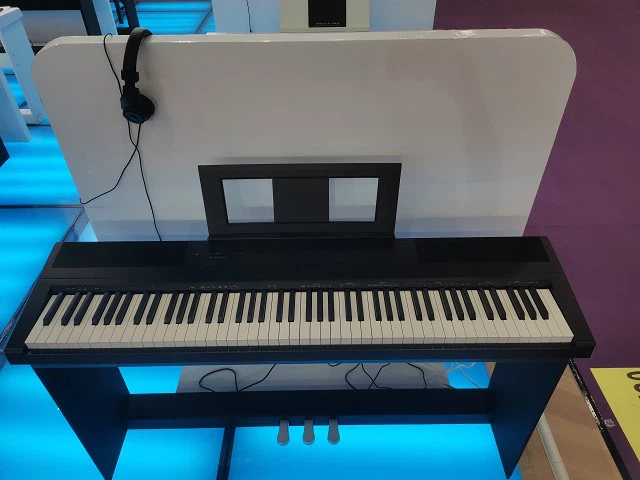
All of these pianos offer a headphone jack (which can double as an output for use with an amp or a recording system) and a connection for a sustain pedal. For most students, that's plenty, but we do give extra points to pianos that support a connected three-pedal module (mimicking that of an acoustic piano). Connections such as a line input and a USB jack for interfacing with computers and MIDI sound modules are useful but not essential.
Special Features
All of these keyboards provide at least a built-in metronome, but some include fully functional rhythm machines. Some offer split modes that allow two people, such as a teacher and a student, to play at the same keyboard or allow one player to access different sounds simultaneously. Some offer recording functions. These features aren't essential for beginners, but they may be useful for the slightly more advanced student or musician.
Ease of Use
In our experience, we've found that most pianists rarely use anything other than the grand-piano sound, and they seldom access a digital piano's special features. So the intuitiveness of each piano's physical controls and LCD readout (if it has one) is not as important to us as other factors. But we do note which pianos are the easiest to use, as well as whether you can use an accompanying app to improve the experience.

Specification of Our 88 Key Portable Digital Piano for Kids
|
Color |
Black |
|
Key |
88-key hammer action keyboard |
|
Model Number |
Dream5704 series |
|
Digital audio source chip |
Imported from France |
|
Souce |
28 polyphony numbers, 238 timbres, 200 rhythms and 100 demo songs |
|
Basic functions |
Electronic switch, volume control, audio output, dual headphone, USB socket |
|
Combination function |
Chord, dynamics, trill, sustain, reverb, metronome, transpose, recording |
|
Optional frame |
1. Wooden frame |
|
Product size |
132.5X29.5X19CM |
|
Product weight |
GW: 15KGS |
|
Packing size |
144X35X24CM |
Frequently Asked Questions About 88 Key Portable Digital Piano for Kids
Q: What is piano?
Q: What is the difference between a digital piano and a portable keyboard?
Q: What does 88 key piano mean?
Q: Do you really need 88 key piano?
Q: Should a beginner get a 61 or 88-key keyboard?
Q: Do all digital pianos have 88 keys?
Q: How big is an 88 key digital piano?
Q: Is 88 keys a full size piano?
Q: Is it worth buying an old digital piano?
Q: Are digital pianos worth it?
Q: How many keys do you need for a digital piano?
Q: Is an 88 key keyboard the same as a piano?
Q: Where do you put a digital piano?
Q: What is the shelf life of a digital piano?
Q: Should you cover your digital piano?
Q: Can you learn piano on a digital piano?
Hot Tags: 88 key portable digital piano for kids-factory, China 88 key portable digital piano for kids-factory manufacturers, suppliers, Portable Digital Piano For Advanced Pianist, Lightweight Stage Piano, Unique Portable Digital Piano, Portable Digital Piano Under 1000, Electronic Portable Piano, Long Lasting Portable Digital Piano
Send Inquiry


