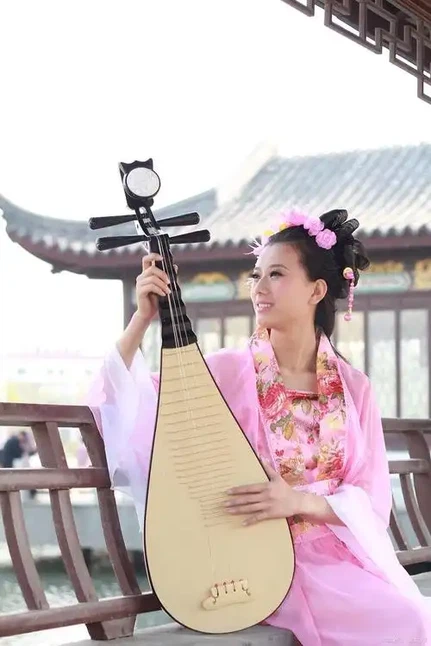
Known as the King of plucked instruments - Pipa
Dec 05, 2024
Leave a message
The pipa is an ancient Chinese plucked instrument that holds an extremely important position in Chinese musical culture as a national instrument. Its origin can be traced back to ancient China. According to the Zuo Zhuan, as early as the Spring and Autumn Period and the Warring States Period, people had already played musical instruments such as the "Seven Strings", which gradually evolved into the later pipa over time. During the Tang Dynasty, the pipa was still a noble instrument that could only be played by court nobles and official musicians. In the Song Dynasty, the pipa had already entered the folk culture. As a widely used form of artistic expression, pipa music played an important role in traditional Chinese music culture.


In traditional Chinese music culture, the pipa is an important instrument for expressing folk music and opera. In ancient Chinese literary, musical, and artistic works, the pipa is often a very important theme. The pipa is a musical instrument transformed from a cultural carrier and has a considerable number of representative works, especially the pipa music that originated from traditional art. They are not only beautiful and melodious, but also rich in emotions, expressing the ancient people's insights into various complex emotions such as life, love, family, and society.
The entire body of the pipa is made up of seven different materials pieced together. Mainly including strings, back, soundboard, neck, shaft, hemp ribs, tail hook, etc. The strings are the core components of the pipa, which has four strings. Strings are generally divided into silk strings, copper strings, and steel wire strings. The back of the qin, also known as the outer shell, is made of refined wood such as paulownia, rosewood, and sandalwood. The soundboard is located at the upper part of the pipa and is also the main source of sound production. It is made of pine, cypress, maple, etc., and its thickness can affect the quality of the pipa's sound. The neck of the pipa is an important part for fixing the strings and is made of paulownia wood. The shaft is a small wooden handle shaped like a pointed cone, located above the pipa. It includes the tuning mechanism of the pipa. Ma Jin is an important component in the pipa. It is located at the bottom of the pipa as a support for the fixed pipa bridge and is also an auxiliary means needed when picking strings. The tail hook is a small hook that closely follows the hemp tendon at the bottom of the pipa. It plays a role in stabilizing the position of the pipa, effectively enhancing its stability and comfort during performance.


The playing techniques of pipa have continuously developed since the Tang Dynasty, and pipa music occupies a very important position in various fields such as folk, court, culture and art. Through continuous development and innovation, the pipa, an ancient musical instrument, is creating new brilliance.